
Fall Colored Corn Harvest, 2025

I talked about my three “larger” patches of colored corn recently in the essay entitled, “My ‘Big’ Patches of Colored Corn as Summer Fades into Fall, 2025” which included some initial discussion about the picking of the Montana Morado Maize (MMM), so this essay will mostly concentrate on my harvesting of the heirloom Ohio Blue Clarage (this will be called OBC here) corn over at my friend “Robert’s” truck garden. At the end, I’ll talk about an initial single afternoon effort in harvesting my Bloody Butcher but I suspect that will be covered more in an essay, probably in January, about “winter” corn, along with some common commodity (but organic) yellow corn ear picking to sell as “squirrel corn”. We’ll see how the next six+ weeks play out.
In my earlier essay, I had thought that the OBC harvest could start in early October but I wanted to get at least half way through my “forensic” walk through and gathering of any MMM corn ears, either those that could be shelled for further seed or the more rare ones that I thought were “people food” grade worthy so my first attempt of bringing home banana boxes of OBC corn didn’t happen until mid-October. My plan was to fill a couple of 5-gallon (18.9 liters) buckets with ears as I walked through the rows and transfer the ears to cardboard (now called “corrugated” by the paper industry) banana boxes for easier transport and storage at home as I processed the ears. The banana boxes would also work well if the ears needed more drying of internal moisture within the kernels to become low enough for longer term storage in food grade buckets. When a 5-gallon “picking” bucket was full, it would be emptied into a banana box and thus, these boxes ended up not being jammed packed tight with ears, which helped in any needed extra drying time.
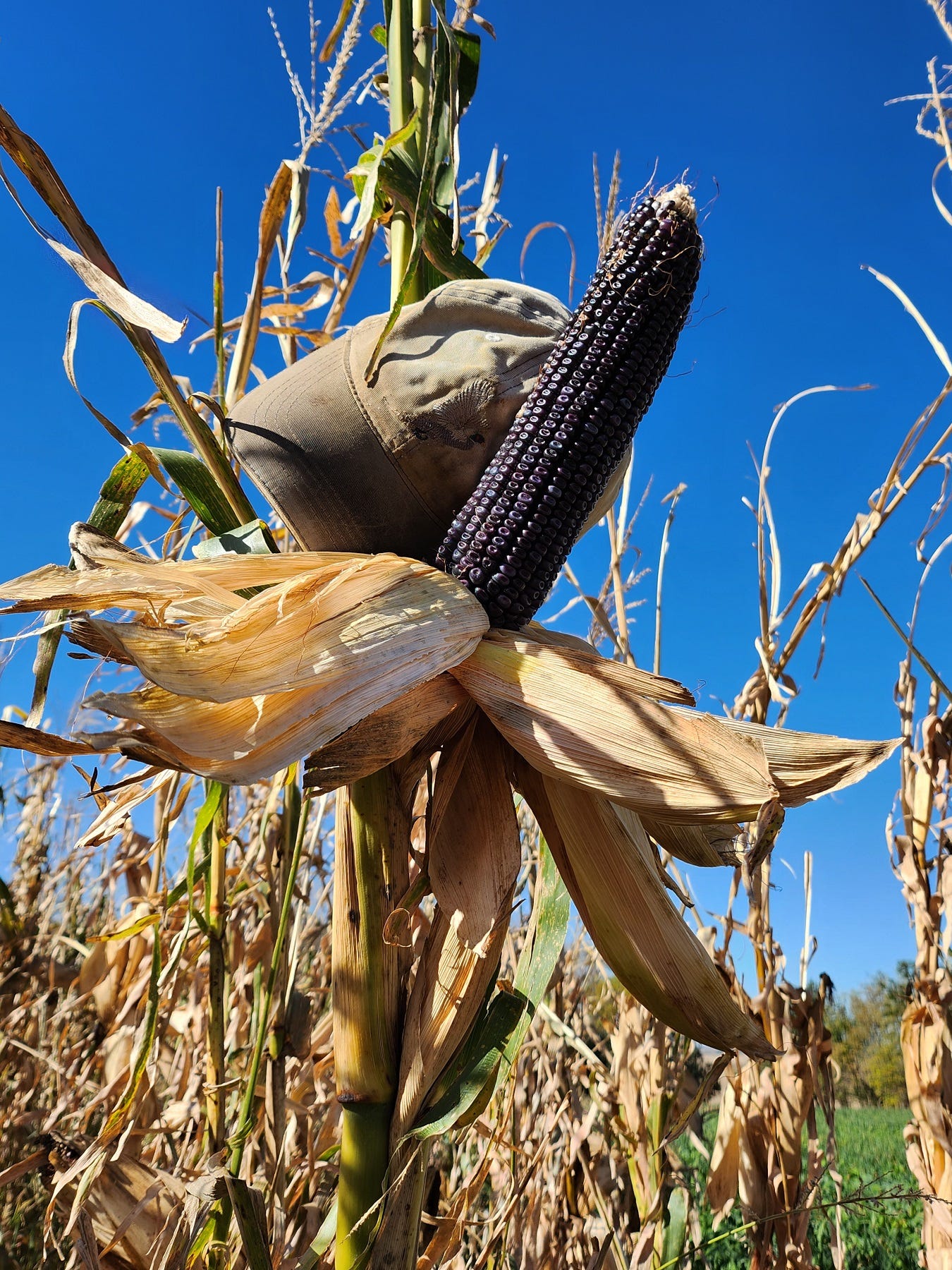
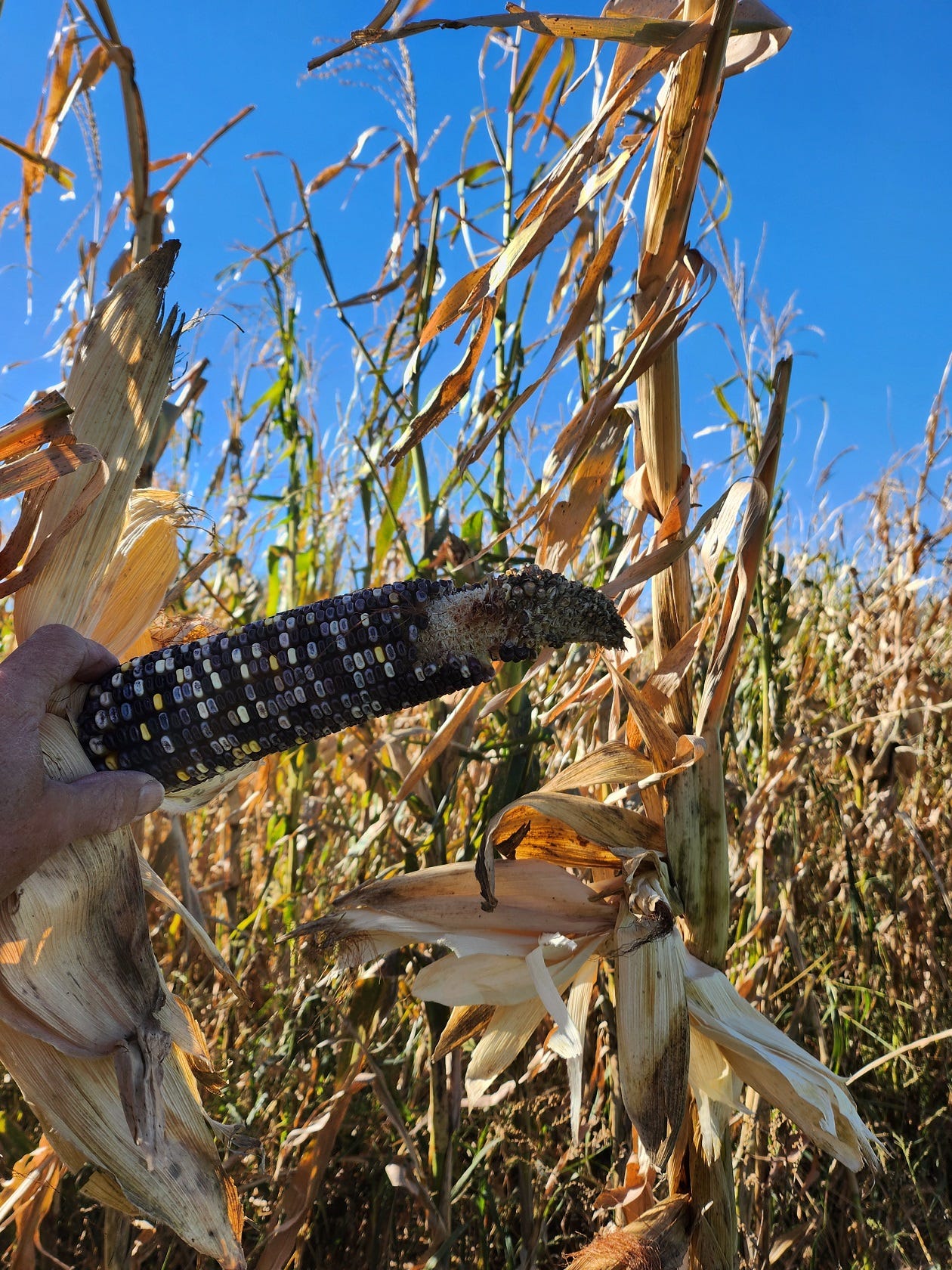
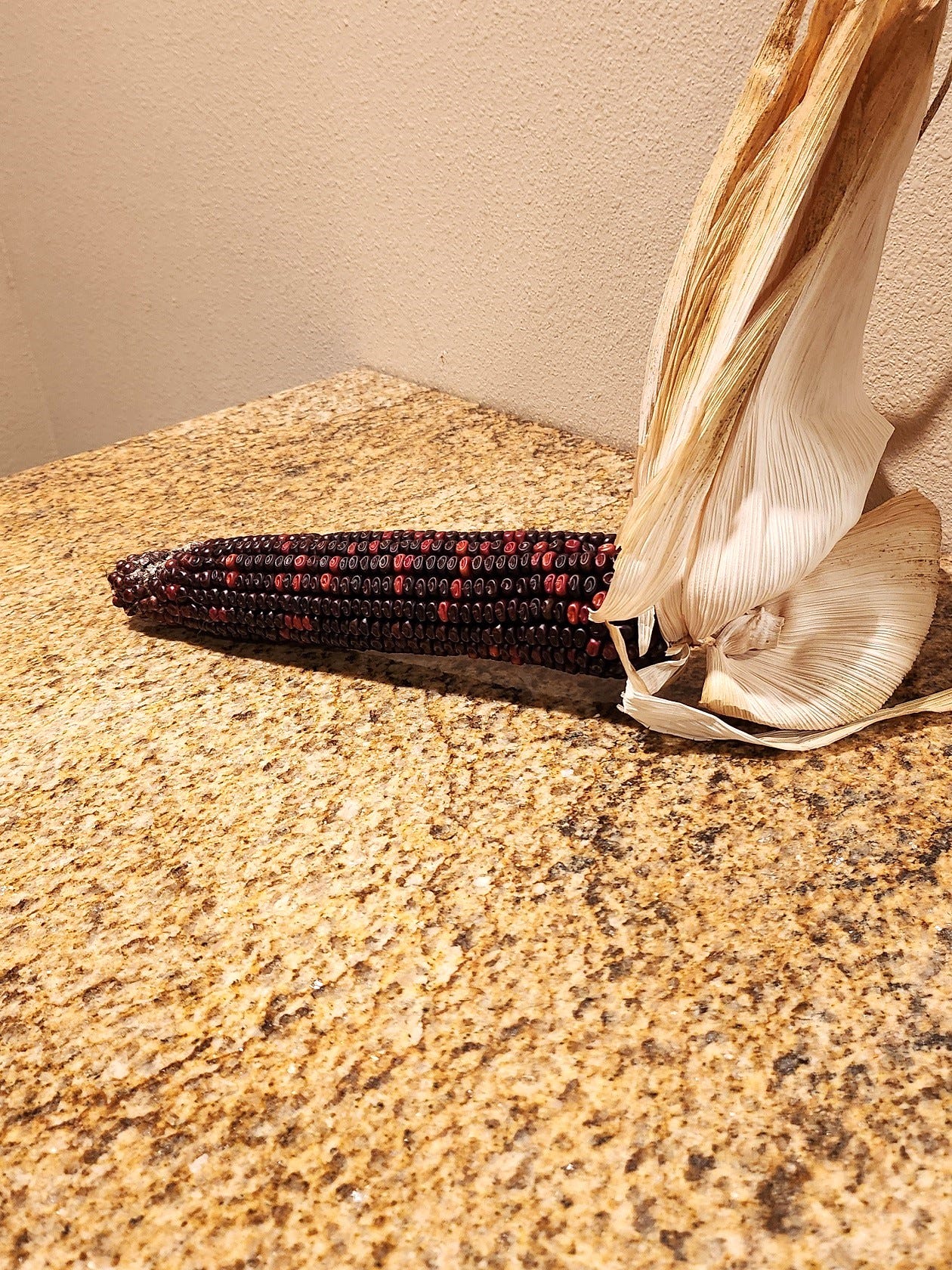
My first OBC pick in mid-October got through the first two rows (the rows on this side of the patch were more complete with the population of plants compared to the other side) and yielded four banana boxes. I wrote the date of the pick on the side of the boxes when I got home and decided that these ears probably needed to wait, including several days in the sun on the backyard patio, before I tried shelling them because they were still “too” wet for easy kernel removal and later storage, although some were already dry enough. The standard phenotype of the OBC were either complete ears of dark blue kernels or mostly dark blue with a few scattered white or pearl-ish colored ones, although this ranged to a violet hue of the blueness or a much more even mix of blue and white kernels or yellow kernels instead of white ones as being the minority intermixing of a specific ear. The rarest phenotype output was two-tone red variant of which I maybe found half a dozen complete ones out of the hundreds of ears that I picked over time.
A typical but large mostly blue ear of OBC corn resting about six feet (1.8 meters) off of the ground; A typical mostly blue but with some white and yellow kernels ear, with the start of deer damage; The rare “red” variant color.
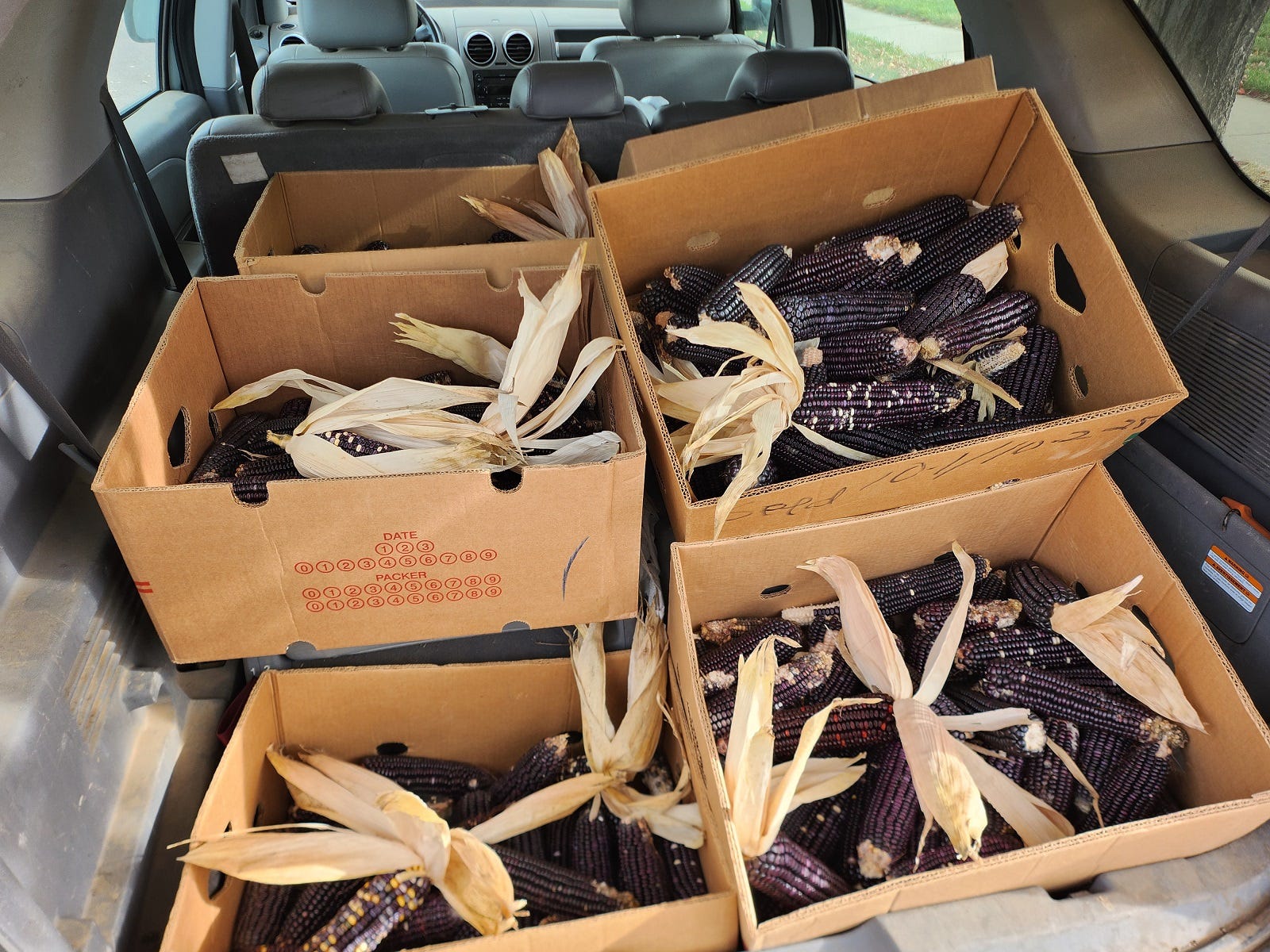
My next trip back to the OBC was on October 26 and yielded six banana boxes. October and into early November was mostly dry and had numerous warmer days so the ears were drying down more in the field, although a few were still occasionally “wet” feeling as I took them off the stalks. I went back twice during the first week of November, with the largest load being eight banana boxes in my car. I think at this point I was through about the first eight or so rows but these were the heaviest with plants (and ears) so the rest of the rows should be faster to pick with a less overall harvest. The amount of deer damage was also increasing, ranging from finding a still mostly closed husked ear munched on to knocked down stalks with the cobs eaten clean of kernels. Some of the pulled down stalks were also from raccoons as the masked bandits were still liking to eat this colored corn. Robert told me that the Minnesota deer season (shotgun slug only in this area) was opening the second Saturday of November and asked if I could take the next week off so they could overlook the patch to see if they could catch any bucks in the still standing corn during shooting light hours. I obliged as this allowed me to get further progress along in shelling the dry enough ears into their more longer-term storage buckets.
Banana boxes of just picked OBC corn ears in the back of the car; A still standing but mostly deer munched ear; Half a bucket of shelled OBC corn.
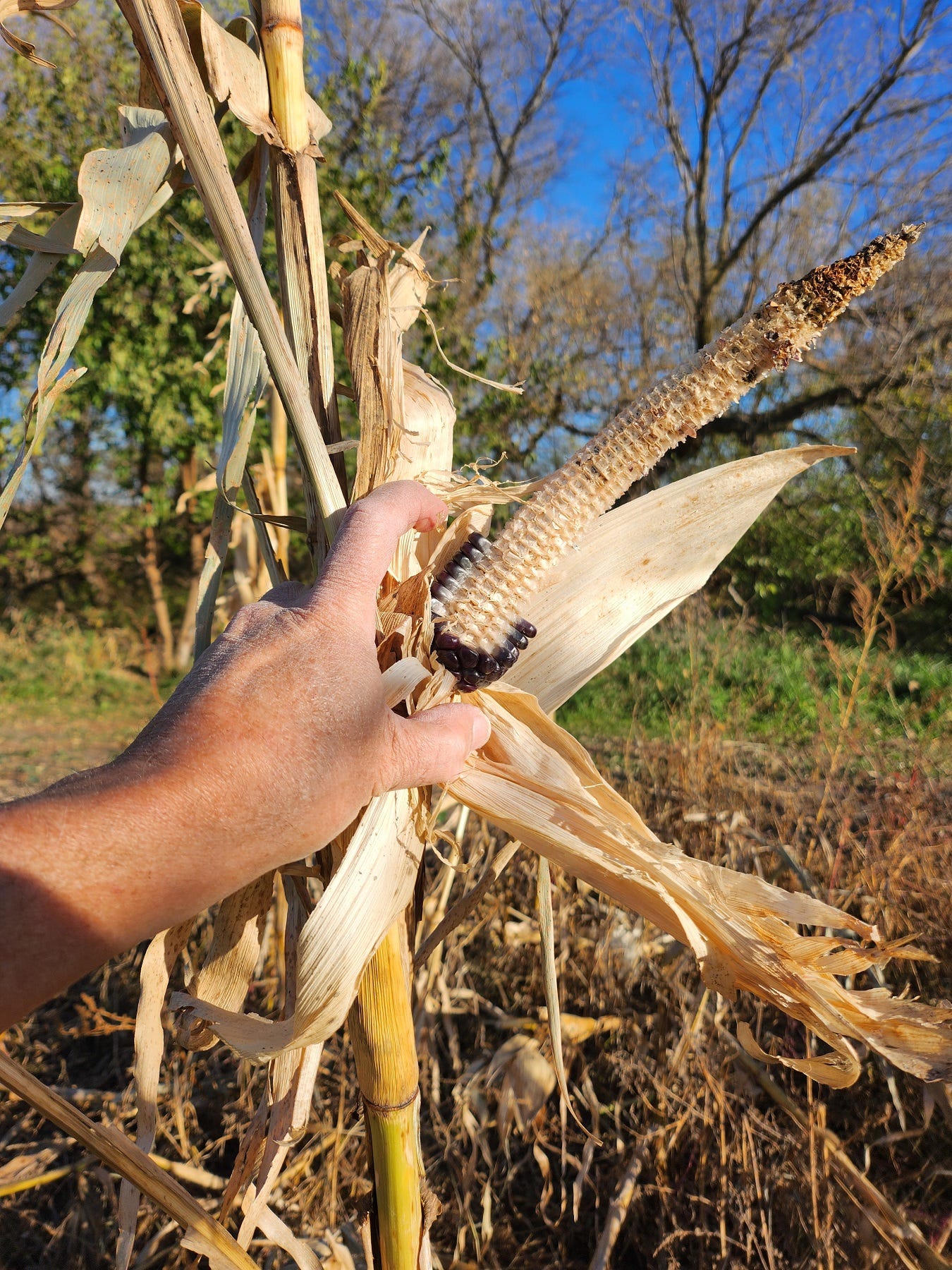
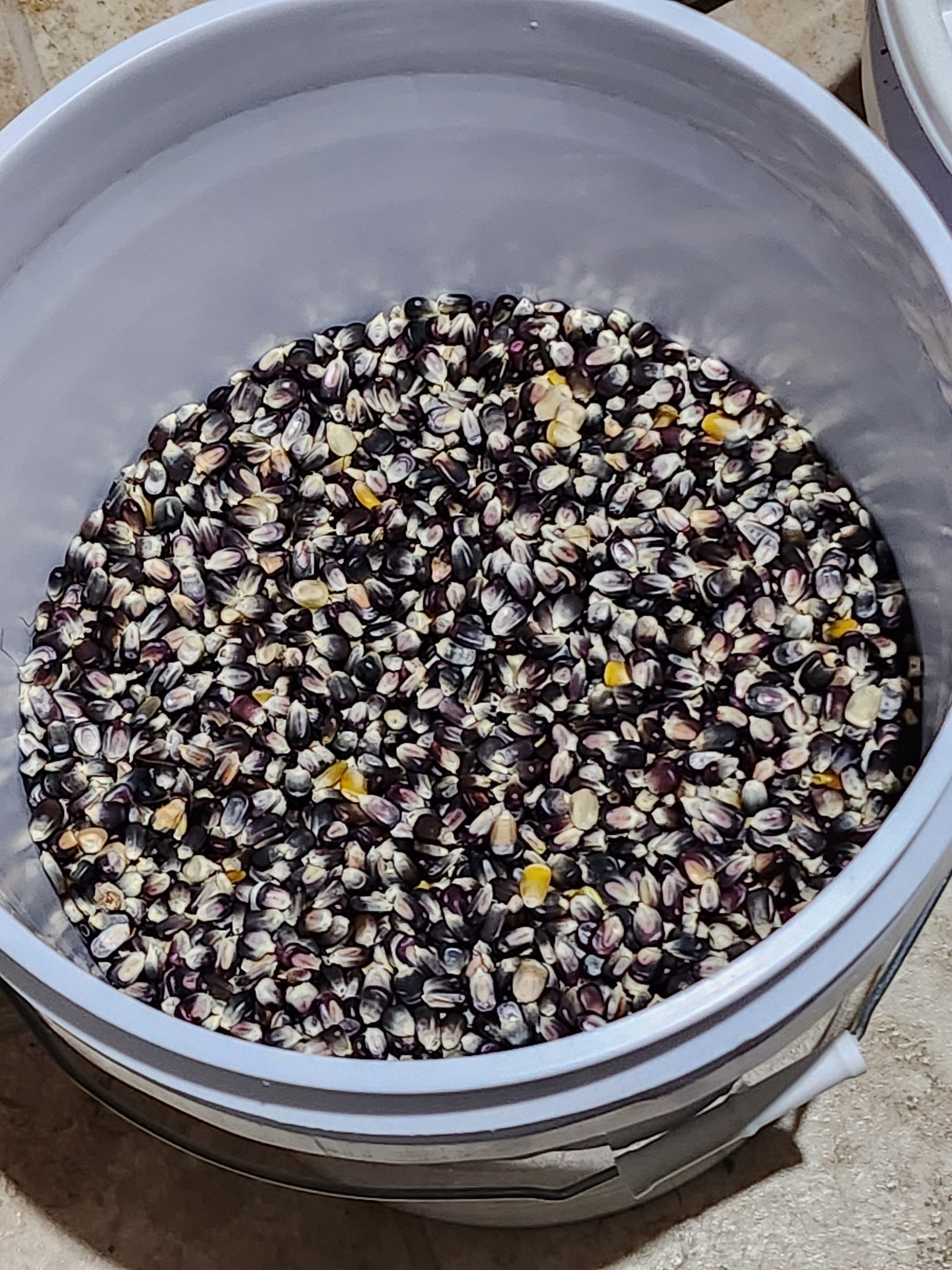
The deer hunting interlude over at the OBC patch allowed me to settle up with some “unfinished business” at the MMM corn patch oval at “Thor’s”. As was briefly discussed in my earlier essay about the initial harvest of the best leg of the MMM oval, the output the “purple” (actually just as much black as a purple seed coat color) was pretty much a disaster. I ended up with about half a 5-gallon bucket of shelled MMM for seed, and with some bags of 2023 grown corn, probably would recover about the same amount that we planted this year. I also ended up with less than half a bucket of “people quality” grain from better looking ears.
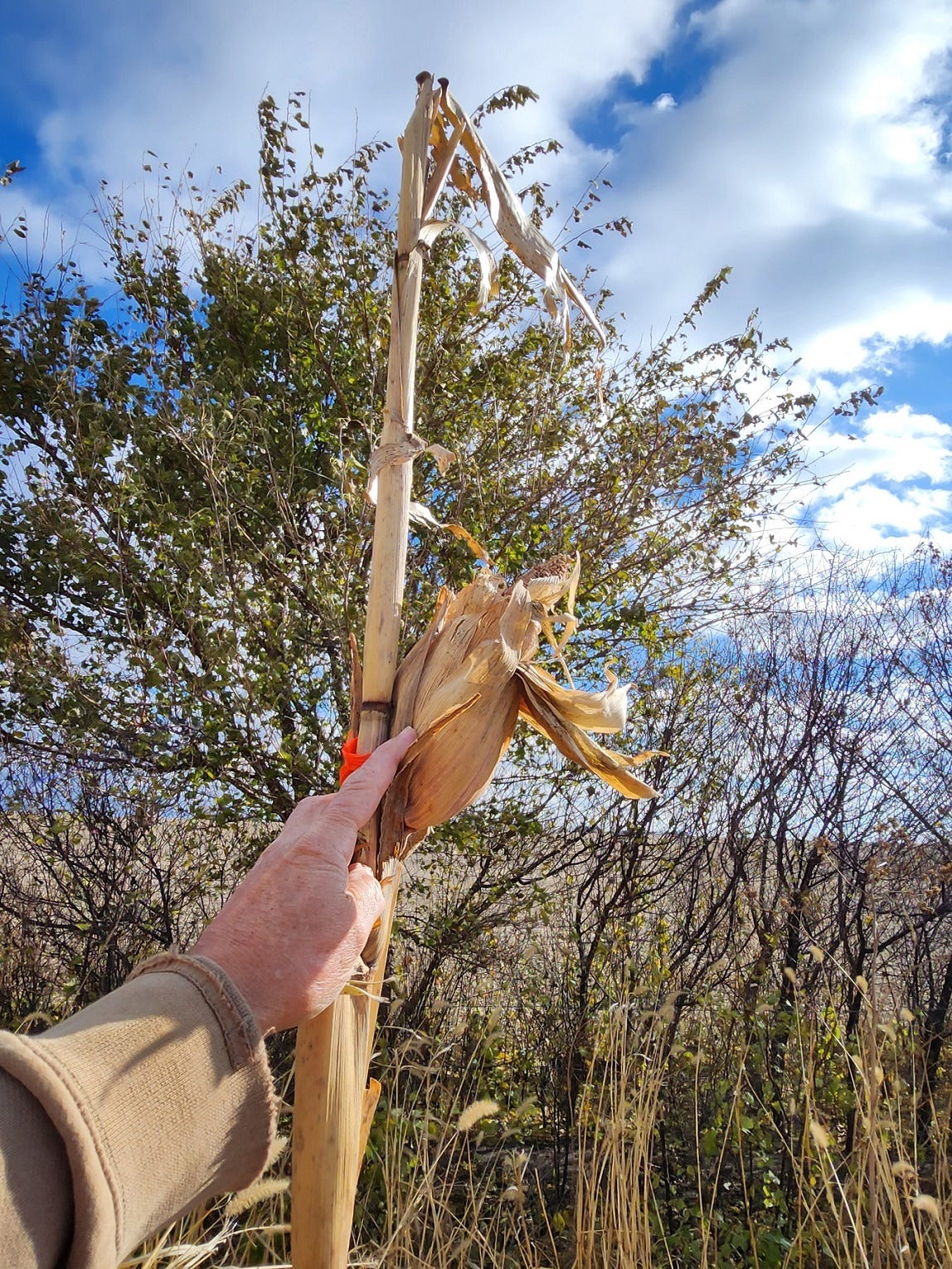
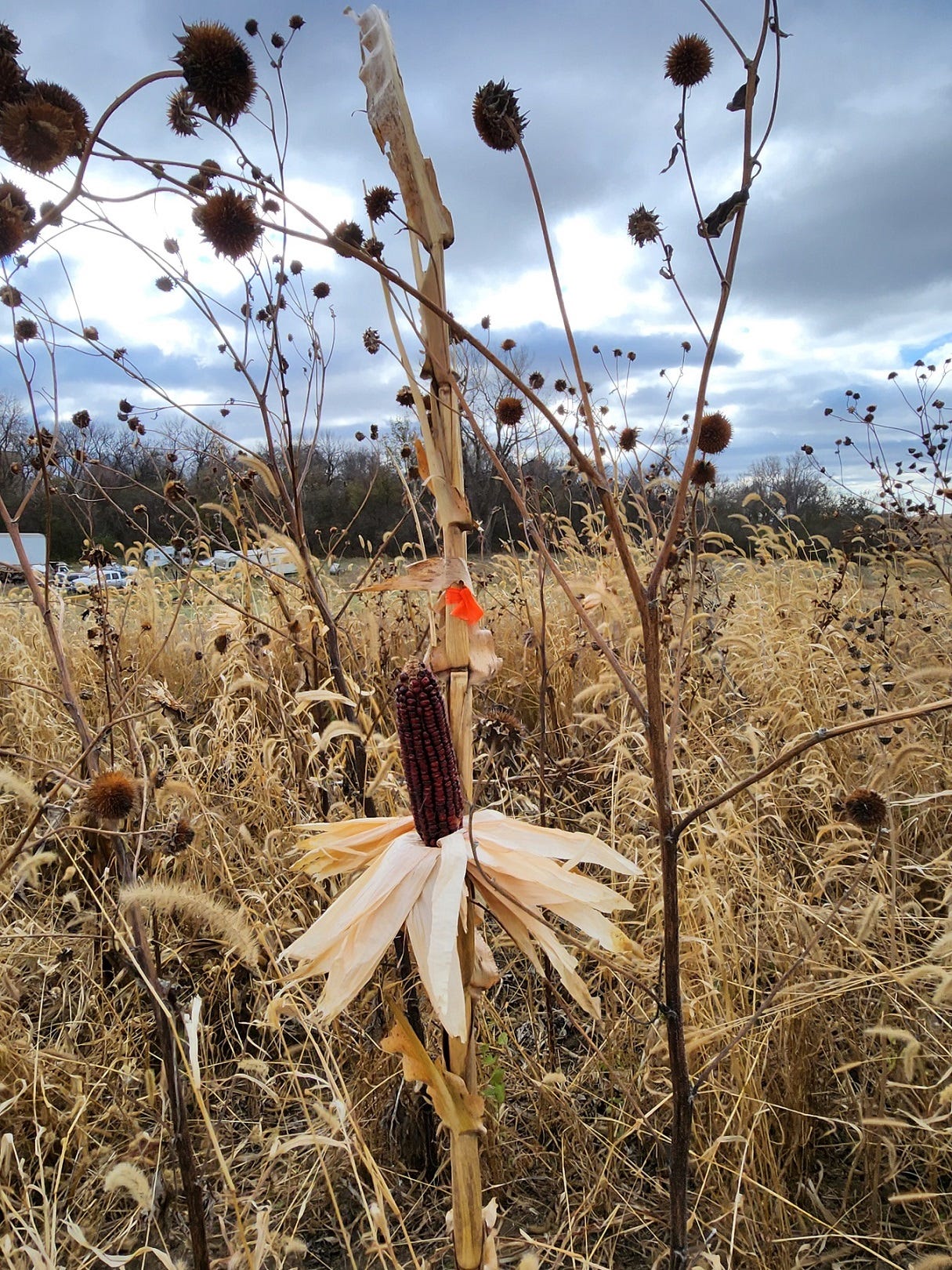
However, there was also some Bloody Butcher that had shown up in the MMM planted oval because although I thought we had cleared Thor’s old seeder of all of the BB seed we planted on June 8, a few remaining kernels, here and there, were way down in the seeder’s drop tubes and these Bloody Butcher seeds germinated among the Montana Morado Maize plants. These two varieties had much different growing length days so the scattered BB plants pollinated themselves and those that ended up with ears ranged from being mostly filled out to only some scattered kernels on the ears. I had marked these BB plants with orange “ribbon” as I did my systematic look for MMM ears in the oval. I was finishing up with things at the garden at “Jalapeno’s” place so stopped by one day in mid-November and picked these “wild” Bloody Butcher ears. I ended up with about three dozen in my bucket, with the best filled out ear the last one I picked 😉.
An orange ribbon marked Bloody Butcher plant standing much taller among the shorter dried up MMM stalks; The last and best “wild” Bloody Butcher ear among the MMM oval.
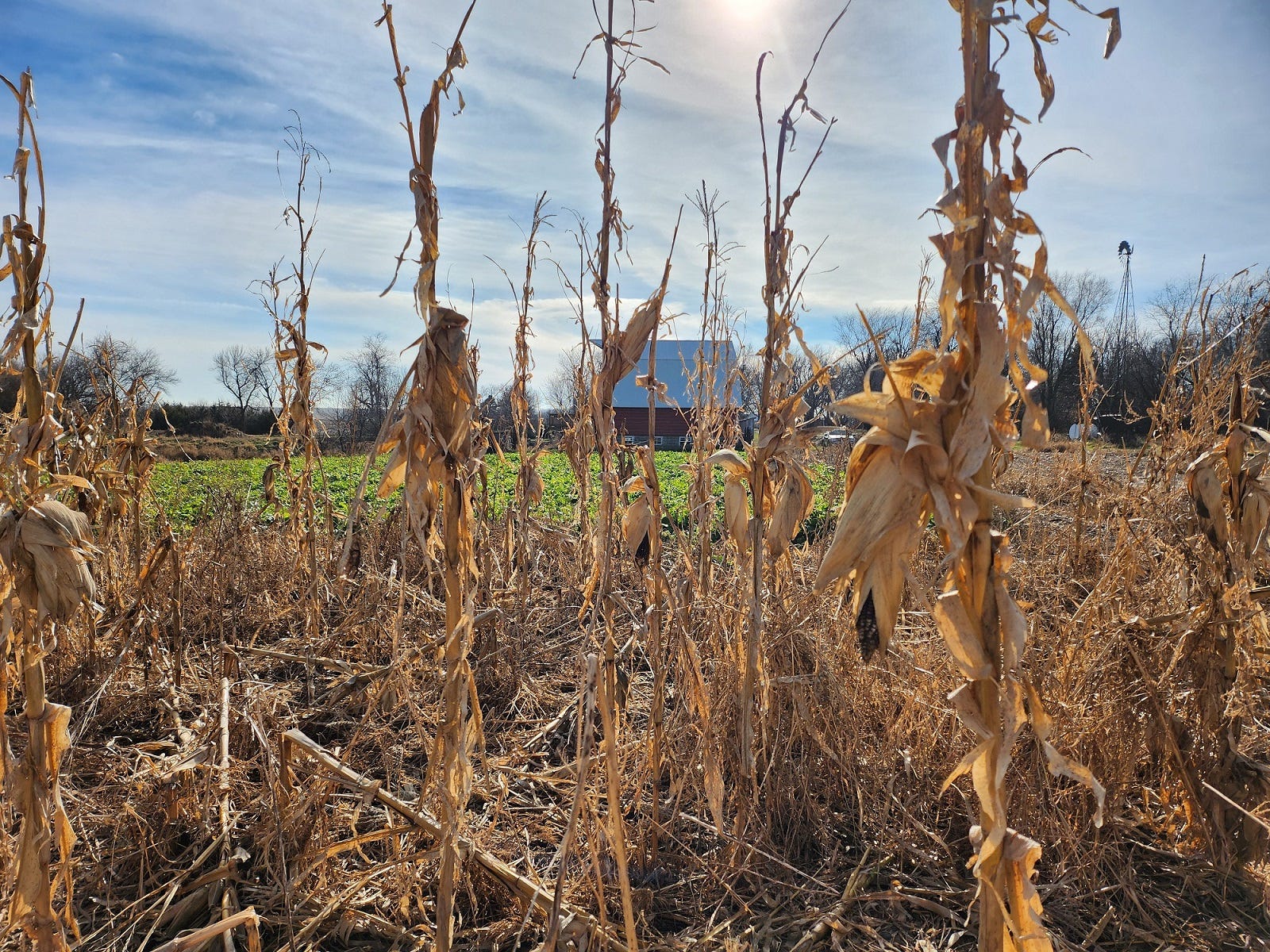
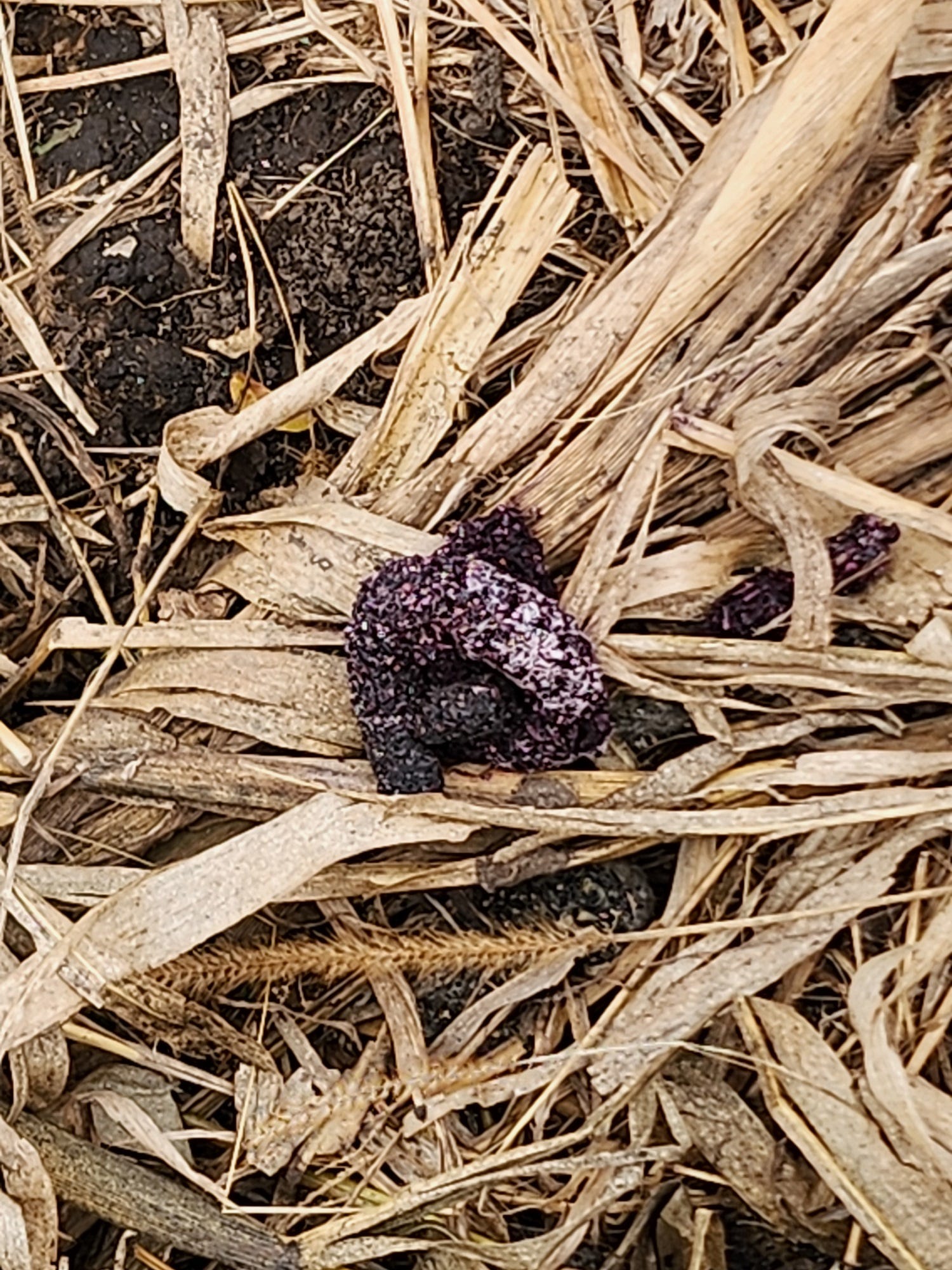
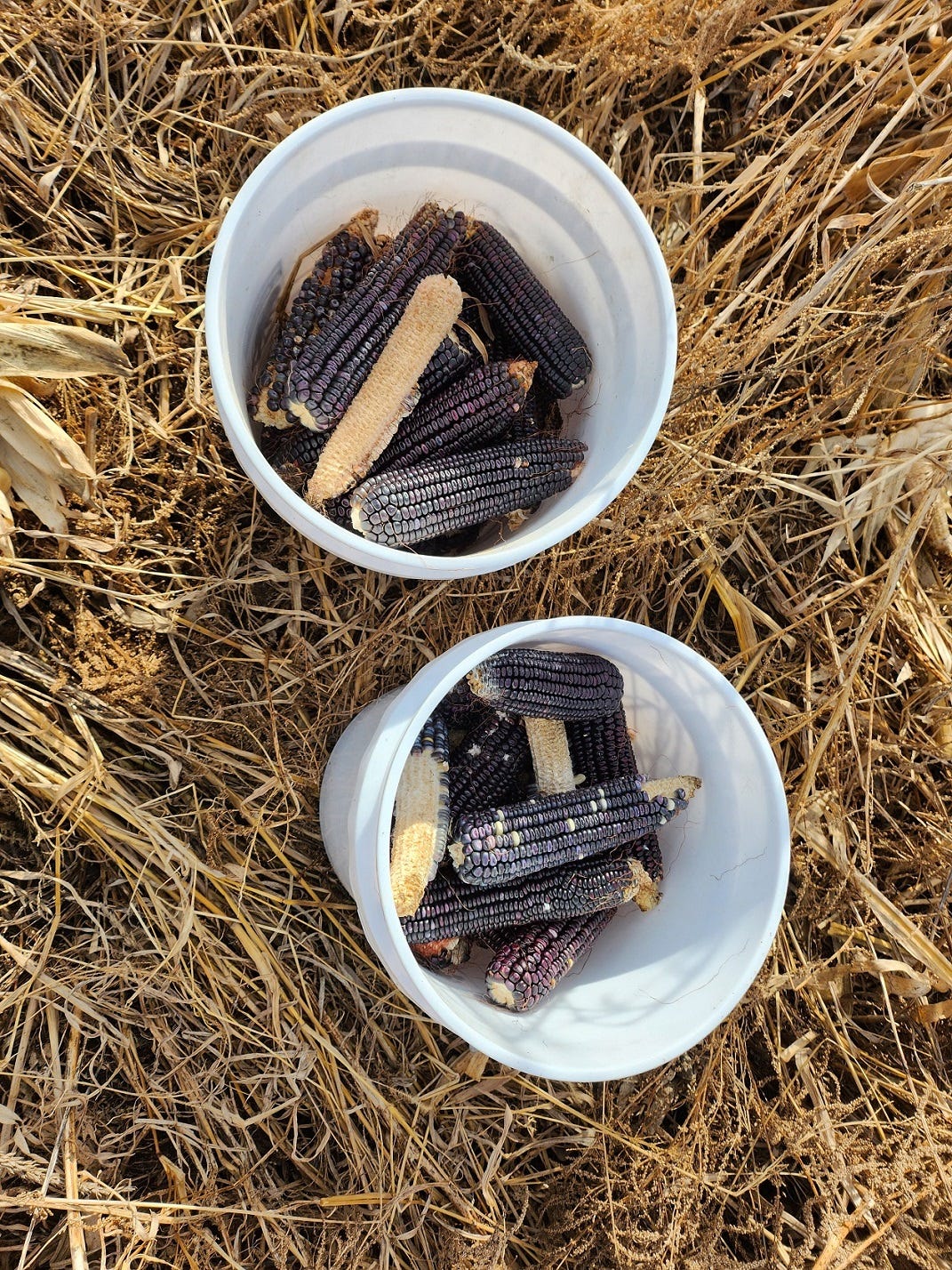
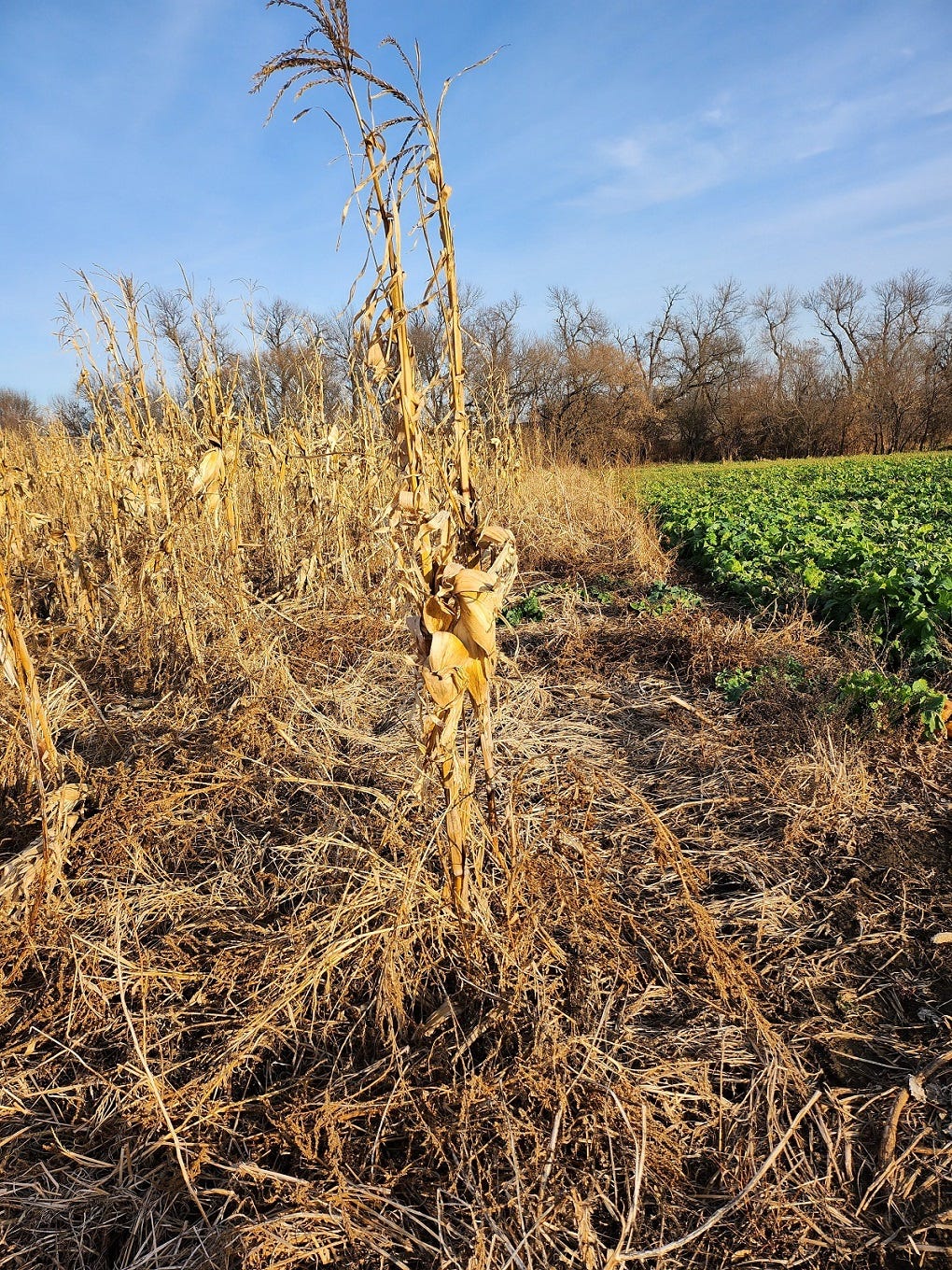
I went back over to the OBC patch twice after the deer hunting season, with “half” the rows left to go through but with the known low plant populations of the last six or so of these twelve remaining rows, and the overall deer depredation, I estimated that the time needed to finish the pick would be much, much less than what had occurred earlier. All my banana boxes were still full of unshelled ears so I just went with buckets these two times. The first trip I filled four 5-gallon buckets and the last trip (November 21) I ended up with three. By this time, the deer and the coons had knocked over more plants and ears than were still standing so the number of full ears were far less than in October or even early November. I anticipated this situation and wasn’t overly concerned about it has I had plenty of OBC ears binned up and had shelled about 130 pounds (59 kilograms) or about 2 ½ bushels by this time. I was more concerned with getting the patch declared “done” before the Thanksgiving Day week and my northern trip happening during the last full week of November. My final tally was about 35, 5-gallon buckets of ears coming out of the patch. Overall, I’m satisfied with the Ohio Blue Clarage harvest, considering that we started with about four pounds of seed. And, as always, there were lessons learned in this growing and harvesting experiment 😉.
Last day of OBC harvesting, looking through the thinner rows on the end of the patch; A raccoon “calling card” among the rows; In progress picking, more and more partially deer eaten ears showing; The last two OBC ears to be picked, Robert’s cover crop of turnips and radishes off to the right side.
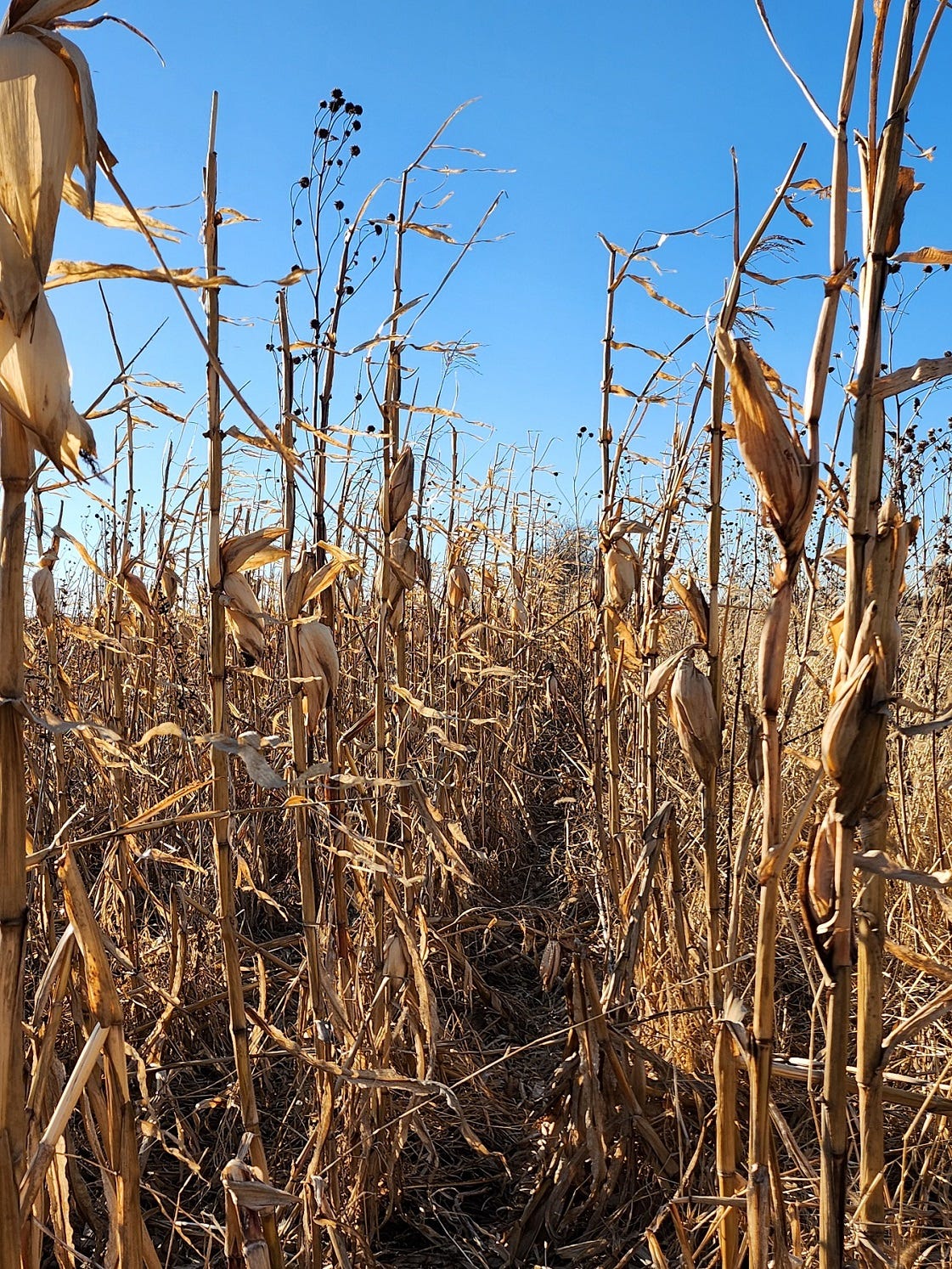
Two days after finishing the Ohio Blue Clarage patch, just to prove a point more or less, I went up to the Bloody Butcher stand and picked the first two rows on the long side of the “triangle” that was against the organic farm’s north fence line. These rows, along with a few of its neighbors to the south, would drift the worst with snow because our winds tend to be from the west, northwest on many occasions with winter storms or afterwards. The fields on the other side of the fence line were basically bare because they had grown soybeans this year. I also wanted to see how long these rows would take in getting picked because they were the greatest in length, at about 100 meters. As the rows went further south in the “triangle” sub-parcel “field”, the length of the rows diminished until near the end of the patch, the rows were only about 30+ feet (9+ m) long.
The deer damage here didn’t seem as bad as with the OBC but there were still plenty of stalks down and ears eaten. It will get worse because the BB patch is now the only standing corn in the organic farm’s area, except for some yellow corn rows on the other side of the farm that Thor has left me to pick as “squirrel corn”. My overall impression of the two rows of Bloody Butcher picked that afternoon was that the ears are generally shorter in length than I had seen grown under better conditions. The 2025 BB had at least three strikes against it because it was planted late, had little fertilizer except for the nitrogen left in the soil from the soybeans grown there in 2024, and the spacing between the plants was too close for this heirloom corn. The latter was probably the most important when it came to the size of the ears. Thor had just finished planting his more modern hybrid (but organic) yellow corn and it can take six to eight inch (15 to 20 centimeter) spacing between plants in the rows whereas I was thinking a foot (30.5 cm) between plants. Thor thinks in the number of seeds planted per acre (or 0.4 hectare), this is how the planter is set up, and somewhere that math versus my inches between plants works out but I didn’t force him to do the calculations during the quick days in June after the early May deadly accident on the farm. So, instead of picking maybe 200+ ears from those first two rows of Bloody Butcher, I had to open and twist off about twice as many smaller ones that often-had littler kernels. My shoulders got a work out that afternoon and with fighting the oncoming darkness, I was glad to finish my fourth bucket of the day.
In my region, late November often sees the start of winter, as with the projected winter storm bearing down on us today, so my first run through the Bloody Butcher certainly seemed to be the end of the fall corn picking season and anything after that will be “winter” corn. I’m heading for more northern latitudes to help my Army “kid” move back to Sodak land and thus, I probably won’t be back out in the Bloody Butcher until mid-December. Its continued easy access is unknown at this point, 4-wheel drive pickup trucks can get through some snow on dirt trails but in deeper snow, it becomes more problematic. I’ve sledded corn out before in the winter and banana buckets stay in sleds better than 5-gallon buckets so we’ll see what happens. Maybe the Army “kid” will use the standing Bloody Butcher as a deer blind for the couple of seasons that will still be open to him when he gets back in state. He has shot a deer before out of my colored corn efforts. Trudging through snow can be good physical exercise and I just have to pay for the gasoline to get there and not any money for a gym membership 😊.
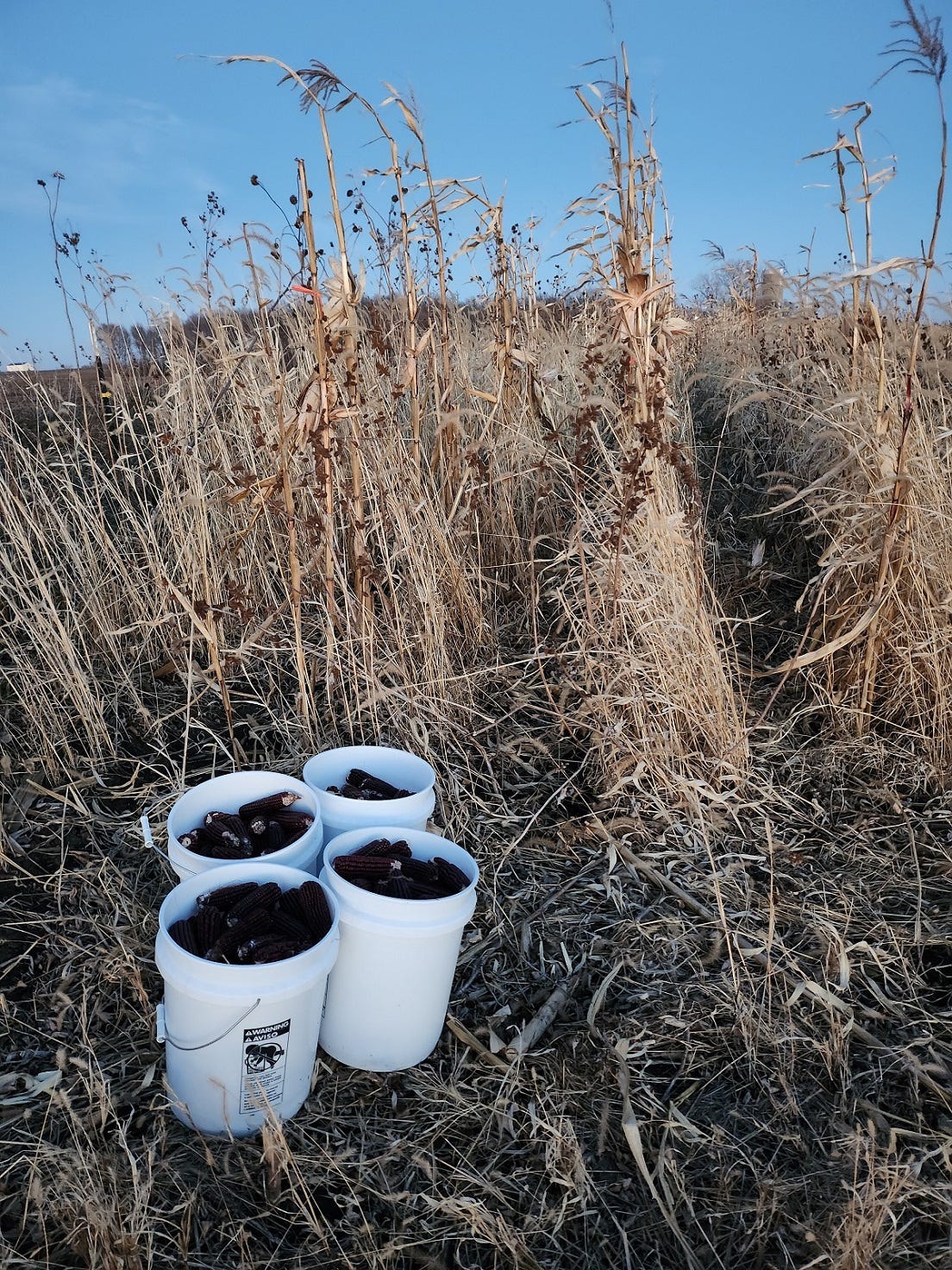
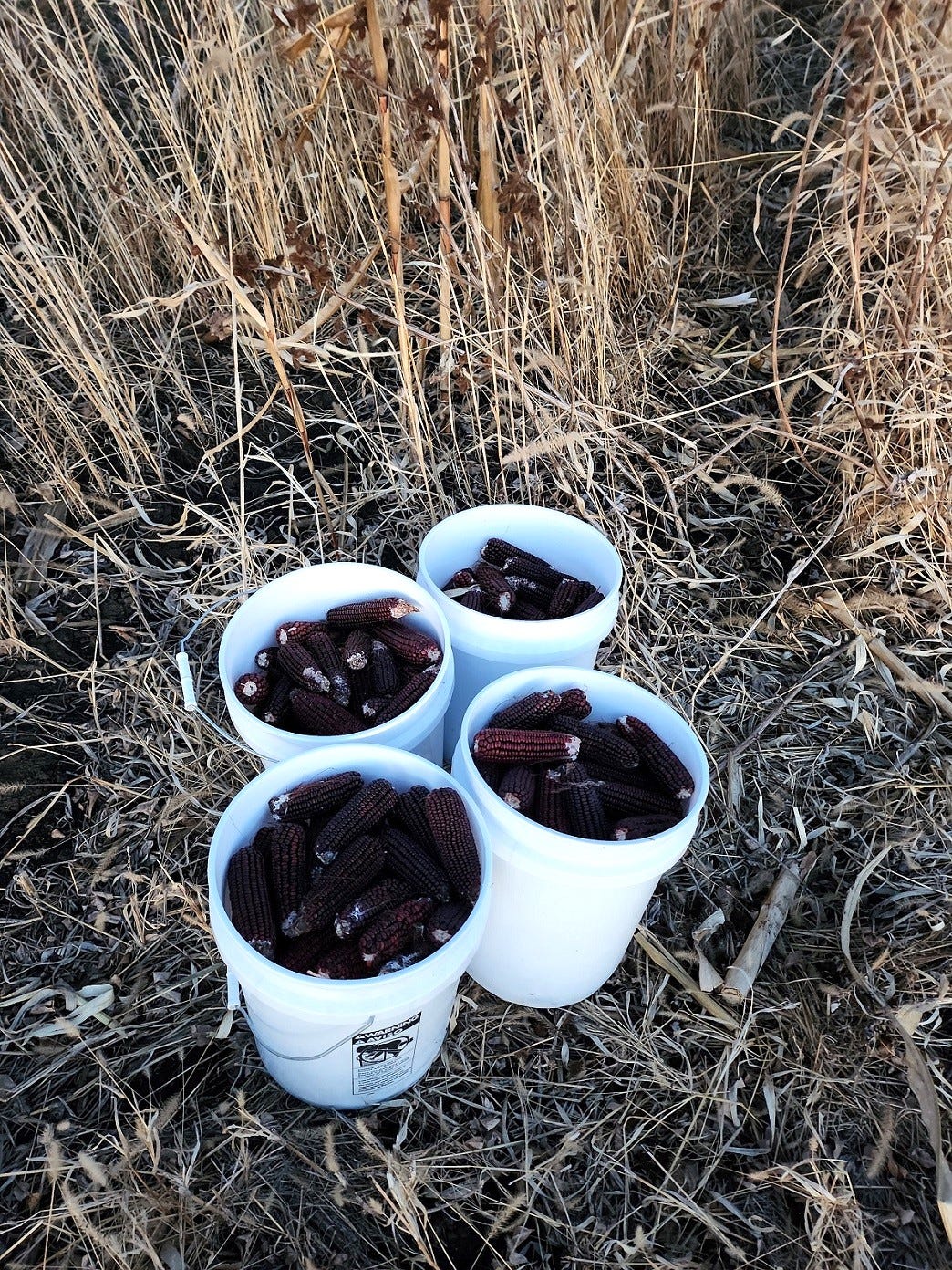
Working my way through the first row of Bloody Butcher just south of the fence line; My 2+ hour haul from the first two rows; A close up of the ears, most of the tips I had snapped off to remove corn borer damage; the GMO guys should like me for being that bug’s treat, thus keeping its growing resistance to genetically altered corn at a slower pace in the area.
If you like this series of essays on Substack, please spread the word. It’s always fun to get new subscribers.
The on-line vegetable seed and corn for home grinding store is open and some germination tests are done for 2026 with the rest to happen in mid-December.
https://dakprstreamseed.us/
Next time: Wrap Up of the 2025 Local Food Selling Season